Landwehr Infantry
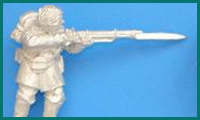
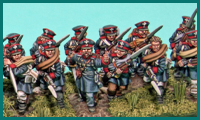
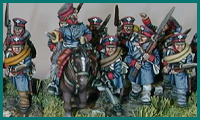
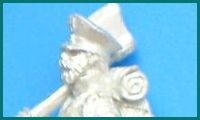
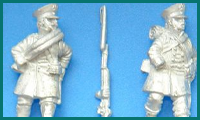
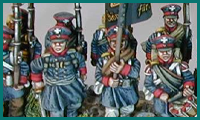
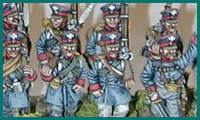
Notes from Calpe Miniatures: "Prussian Landwehr. 1813-15. (Code PL.) - These figures wear the distinctive uniform of the militia. The salient features of this uniform are as follows-
(a) The men were issued with caps based on a style popular with civilians at this time. These were made locally resulting in minor differences between the caps produced by the various provinces. Commonly the cap had a peak and a strap which fitted under the chin. It was decorated with a hat band and piping round the crown, in the provincial colour. On the front was attached a white landwehr cross and a small Prussian cockade. These caps were generally Prussian blue but grey and black versions are mentioned. Some battalions, particularly in the Silesian formations were issued with British stovepipe shakoes.
Click here to read more...
(b) Most men wore the litweka coat. This was a knee length coat with a high collar and a double row of buttons on the chest. The most usual coat colour was Prussian blue, but grey, black and brown coats were also issued. Facings were in the provincial colour. These were invariably displayed on the collars of the jackets, but there was a great variety when it came to the cuffs. Coats were all manufactured with round cuffs; some had full provincial colour cuffs, others had a line of piping along the upper edge of the cuff and many were issued with just plain cuffs. The colour of the shoulder straps denoted the number of the battalion within the provincial regiment in the following order- white, red, yellow, light blue.
(c) Equipment came from a variety of sources and was far from standard. It is a fallacy, however, to think of these troops facing the French with pikes. By the time they went into action in 1813 most of these men had received muskets of some kind, many supplied by the British. Cartridge boxes were mostly of pre-1807 vintage, used but functional, and carried on a black belt over the left shoulder. The preferred sidearm was an axe slung from a black cross-belt. NCOs often acquired, or were issued with, sabres as were worn by the line musketeers. Many men simply had nothing other than their musket and bayonet. Backpacks were made of off-white cloth or canvas, with straps in the same colour. They were also issued with a haversack, worn generally on the left hip, and made of the same material as the backpack. All water bottles were personal acquisitions by the men.
(d) Most provinces issued the men with long trousers usually of some white material although grey cloth was also common. Many men simply wore the trousers they had brought from home. These were often worn long although it was common practice to tuck them into the gaiters if they were issued, or just rolled up to clear the mud.
(e) Officers wore one of two uniforms. If they had served in the regular army at any time they usually wore the same uniform as a line officer but with a landwehr cap. Many of these adopted the litweka for campaign use. Those officers which had never served in the regular army invariably wore the litewka. They could be distinguished from those officers with a regular commission as they did not wear the silver officers sash round the waist.
(f) Lastly a word about flags. Landwehr battalions did carry flags. They were created for them by their wives or other family members, or bought for a battalion by the town or district which had raised it. These flags were usually based on the landwehr cross (white cross on a black background) but in many cases a provincial theme was adopted (e.g. many Silesian units carried a flag displaying the Silesian eagle in chequered red and white, on a sky blue background.)"
Return to: All Categories or All Products