Line Jaegers and Schuetzen
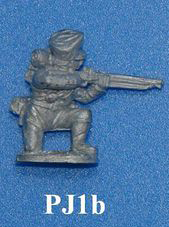
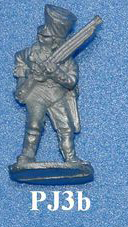
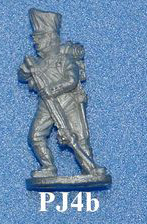
Notes from Calpe Miniatures: "Prussian Jaegers & Schuetzen. 1813-15 - There were several important differences between the uniforms and equipment worn by these troops and those worn by the rest of the line infantry (musketeers, fusiliers, etc.). They were as follows:
These troops were armed with a rifle not a musket.
They wore a dark green kollet. This was cut in the same style as the line infantry kollet. Facings were dark red for the East Prussian Jaegers. Their cuffs had no flap as they were cut round in the Swedish style. The Silesian Schuetzen Battalion had black facings piped in poppy red. They did have a cuff flap in the same green as the kollet.
Click here to read more...
Both jaegers and schuetzen wore a belt round the waist. The purpose of this was to draw the rest of the equipment close to the body to lessen the risk of entanglement. It was not used to carry belly-pouches as was sometimes the case for the volunteer jaegers.
The cartridge pouch belt (worn over the left shoulder) was decorated with brass pickers, chains and a flask containing finely ground powder. These were vital pieces of equipment for the function and maintenance of the rifle.
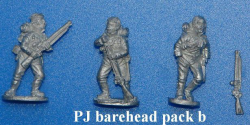
They were also armed with a straight sword-bayonet. This was only fixed when absolutely necessary as it interfered with the use of the rifle and increased the risk of snagging.
The greatcoats were carried strapped to the top of the pack, not rolled and worn over the left shoulder. These figures are often depicted wearing a greatcoat roll but these illustrations are invariably modern ones. Contemporary sources and the Knotel prints and pictures, always show them with the coat strapped to the pack. This would make sense as a coat roll would negate the issue of the waist belt and once again increase the possibility of entanglement. For the same reason no haversacks were carried on the left hip.
The rest of the equipment and uniform items were standard issue:
Black canvas knee gaiters. The East Prussians were originally issued with marching boots but they were subsequently issued with gaiters in 1813 and used these on campaign. The Silesians only used gaiters. NCOs in both formations used marching boots to emphasise their status.
Grey breeches tucked into gaiters or marching boots.
Covered shakoes.
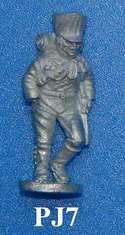
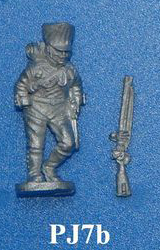
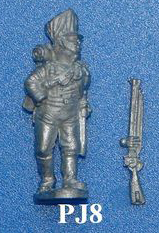
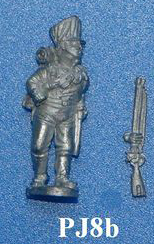
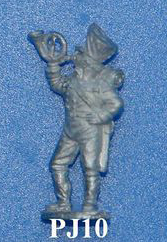
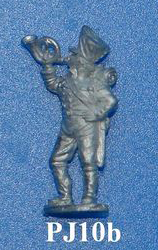
Note: there are two variants for each code number. The first is for the East Prussian Jaegers. These figures have Swedish cuffs(round cuffs). The (b) variant of each figure is for the Silesian Schuetzen; these figures have Brandenburg cuffs (cuffs with a flap)."










Return to: All Categories or All Products